
DSP-powered precision monitoring
The Genelec 8330A is a high-end nearfield studio monitor designed for precise, digital audio workflows in professional environments. Building on the legacy of the 8000 series, the 8330A integrates Smart Active Monitoring (SAM) technology, offering unmatched room calibration, imaging and reference-grade clarity. Whether you're mixing music, mastering, or performing sound restoration, these monitors deliver uncoloured, analytically accurate reproduction.
After years with the 8030C, I've transitioned to the 8330A, and the leap forward is immediately apparent. The 8030C offered phenomenal analogue performance, but the 8330A's DSP and full integration with Genelec's GLM calibration system bring a level of precision and adaptability that analogue-only systems can't match. These monitors make it possible to trust every mix decision, even in less-than-ideal acoustic environments.
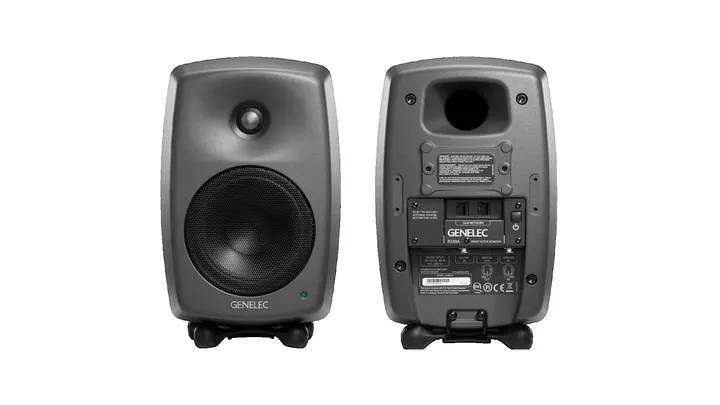
The details
- Configuration: bi-amplified, 50W LF + 50W HF Class D (100W total)
- Drivers: 5" woofer, 0.75" metal dome tweeter
- Frequency response: 45Hz - 23kHz (±1.5dB), 38Hz - 25kHz (-6dB)
- Max SPL: 104dB at 1m
- Inputs: 1 x XLR analogue, 1 x XLR AES/EBU digital
- Weight: 11.7lbs (5.3kg)
- Dimensions: 11.8" (H) x 7.4" (W) x 7.06" (D)
- Amazon ASIN: B01E8XH048
Smart Active Monitoring (SAM)
The 8330A's defining feature is its DSP-based Smart Active Monitoring, which works with Genelec's GLM software to calibrate the monitors to your room automatically:
- Automated phase and EQ correction via a reference microphone
- Time-of-flight alignment and level balancing
- Compensates for early reflections and acoustic anomalies
- Saves settings internally, so there's no need to run GLM every session
The rest of the Genelec toolkit is here too. The Directivity Control Waveguide (DCW) gives a wide, stable stereo image and predictable off-axis response. The Minimum Diffraction Enclosure (MDE), an aluminium cabinet with smooth edges, eliminates diffraction artifacts. The adjustable Iso-Pod stand decouples the monitor from surface vibrations and lets you set precise tilt. Intelligent Signal Sensing (ISS) powers the monitors down when idle.
Where they excel
- Professional studios: ultra-flat response, superior transient accuracy and DSP room correction mean mixes translate across systems. The AES/EBU digital path supports fully digital broadcast and post-production chains.
- Project studios: where full acoustic treatment isn't practical, GLM calibration adapts to standing waves, boundary reflections and awkward speaker placement. Low-end extension to 45Hz (38Hz at -6dB) is capable even without a sub in many rooms.
- Sound design and post-production: consistent time-domain accuracy and phase coherence, essential for dialogue editing, Foley, ADR and spatial placement.
- Multimedia workstations: compact enough for tight desks, with a pristine digital input path and a neutral benchmark for headphone-to-monitor referencing.
Where they're less suitable
- Large rooms: like their analogue siblings, they need a sub for large-space coverage.
- Mobile recording: the GLM calibration system isn't optimised for portability.
- Ultra-low frequency monitoring: add a sub (such as the Genelec 7350A) for full-range reproduction.
Verdict
The Genelec 8330A takes everything the 8030C did well and elevates it with digital signal processing, advanced room calibration and better control over your monitoring environment. For professionals needing absolute confidence in their mix decisions, especially in non-ideal rooms, the 8330A is an unmatched tool. Smart, compact and brutally honest: this is the future of nearfield monitoring.
Worth knowing: high-end monitors like these are commonly sold as single units, so you can outfit a studio in any configuration, and buy replacements or upgrades one speaker at a time. The link above is for a single unit.